
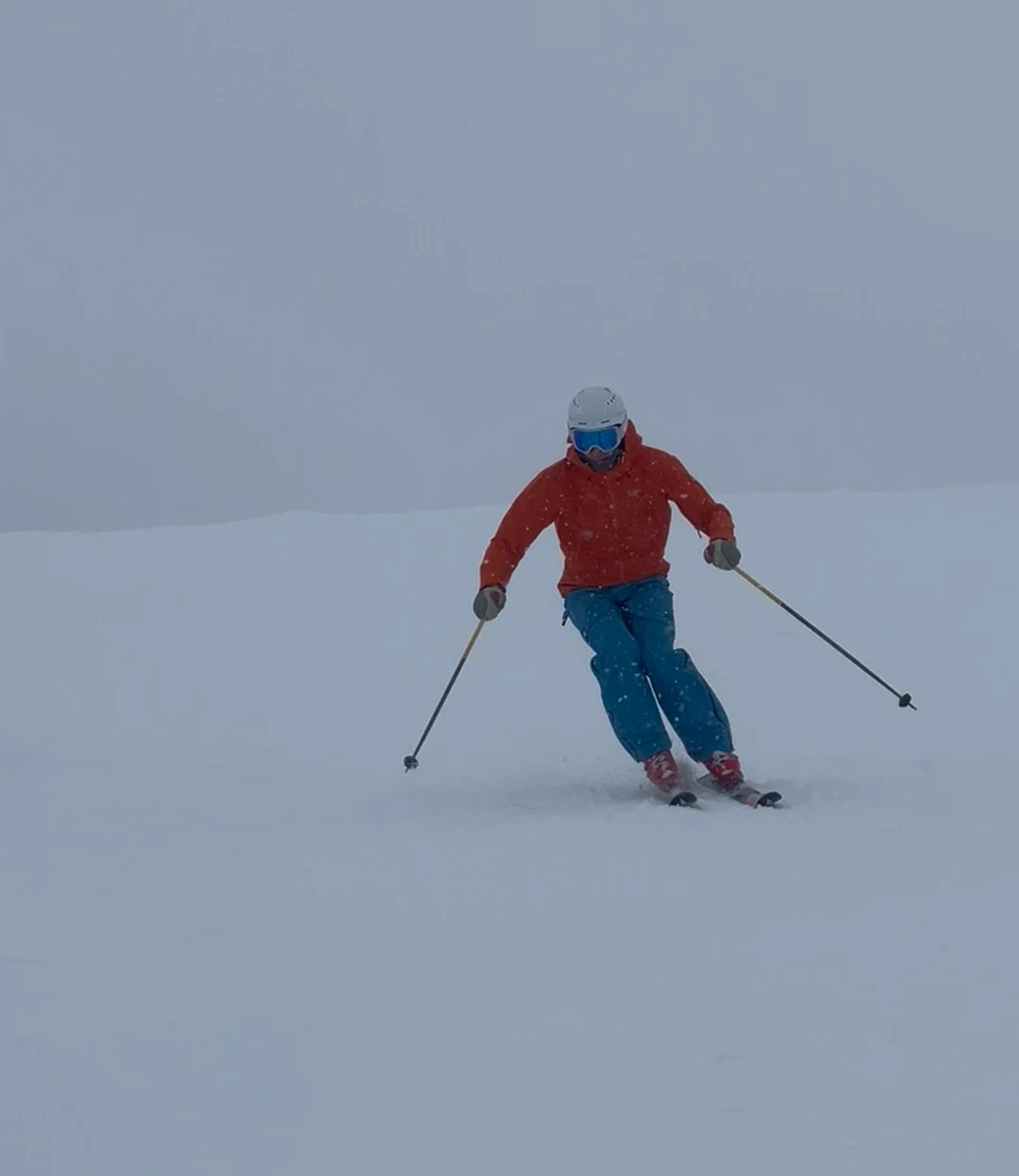
Watching your own ski video can be quite confusing. You keep playing it over and over again, and you can’t quite tell what’s going wrong. Something just looks off or feels wrong. You can see the result, but what caused it? What could you change?
You can use a ski coach’s approach to review your own video. Ask yourself: What was I trying to do, what actually happened, and what single change is most likely to help?
This is often described as Observe → Evaluate → Prescribe. Together with knowledge of the intent (what were you trying to do), this gives you a practical 4-step process for reviewing a ski run.
1. What were you trying to do?
Before deciding that anything is wrong, understand the goal of the run.
Were you trying to make short turns or long turns? Carved turns or skidded (brushed) turns? Were you trying to control speed, keep a steady rhythm, or simply ski a difficult slope with confidence?
Also consider the context:
- What were the terrain, snow, visibility, and traffic like?
- Was this normal skiing or a drill?
- What felt difficult during the run?
The same movement can be useful in one situation and unhelpful in another. Skis drifting sideways are a problem if the goal was a clean carved arc. They may be exactly right if you were making speed-controlled skidded turns.
Do not rush to judge yourself that you can’t do dynamic short turns or that you can’t handle steeps. A video shows how you handled one task in one set of conditions. For this review, the more useful question is:
What would a successful version of this run look like?
Your answer becomes the standard for the rest of the analysis.
2. Watch yourself skiing
Watch the full run at normal speed at least once. The replay in slow motion at 0.5x or 0.25x speed.
- Are you in control of speed and direction? Or do you slowly pick up speed and are turns becoming ever bigger?
- Are speed and rhythm consistent? Are left and right turns similar?
- What are the skis doing? Is edging building up or are skis staying mostly flat? Are the skis steering and consistenly forming rounded turns or are they for instance twisted side-ways making zig-zaggy turns?
- Where does the skiing start to look less effective?
- What is the rest of the body doing? Are you in an appropriate athletic position?
- How does the body move relative to the feet?
- Is the line appropriate for the intended turns?
The best turn is useful. It shows what you can already do and gives you a realistic comparison for the weaker turns.
Next, choose a few representative turns and watch them again. Look at the skis before focusing on body positions. Notice when the skis release their old edges, how they enter the new turn, where they grip or slip, and where most of the direction change and braking happen.
Then look at your leg and body movements as a possible explanation for what the skis did. Did your legs release smoothly? Did your body move into the new turn? Did a hip or upper-body rotation appear just before the skis changed behavior?
Keep your notes factual:
- Observation:“My skis are sliding excessively and I don't look well balanced.”
- Not yet a diagnosis:“I am afraid to tip my skis.”
One unusual turn may just be a recovery. Give more weight to a pattern that repeats at the same point in several comparable turns.
Watch the outcome of the skis first. Use the body movements to explain what happened at the skis.
Observe → Evaluate → Prescribe
3. Form one opinion about what needs to improve
Now compare what you observed with how you intented to ski. What is the biggest difference between the intended result and the actual result? A useful opinion has three parts:
At this point in the turn, I see X. That makes the skis do Y. I think Z may be contributing to it.
For example, imagine the goal was to make round, skidded turns at a consistent speed, e.g. basic parallel skiing:
- XWhat you see: The skis stay too flat at the apex (mid-turn when the skis point downhill)
- YThe effect: You are skidding sideways exessively and have a hard time staying balanced on the packed snow.
- ZYour opinion: Legs stay relatively straight and lower legs/boots are not able to build sufficient edge.
Work backward from the visible problem and look for the earliest repeatable movement that you can realistically change. Then choose one priority that:
- affects your intended outcome;
- happens in several turns; and
- can be tested on the next run.
Treat your conclusion as a hypothesis. Your skis staying too flat could come from technique, but it could also come from fear of acceleration, physical limitations, equipment, or terrain that feels too difficult. Your video alone rarely proves why something happened. Use what you remember feeling during the run to narrow down the possible reasons.
A good analysis therefore sounds like this: “This is what I see, this is how it affects the skis, and this is the first thing I would test.”
4. Test one change — and know why
A drill is extra useful when it connects directly to your opinion about the run.
Use this simple prescription:
Try this drill because it helps with this movement or ski outcome. I will know it worked when this visible result changes.
For the flat skis example, you might decide to do the side-slip to edge-set drill:
- 1On a ski slope with relatively packed snow, stand facing across the hill. So that the skis are perpendicular to the fall-line.
- 2With your knees slightly bent, release the edges (flatten the skis), until you start sliding sideways downhill
- 3Once you start sliding, edge the skis again by pushing your knees towards the hill (uphill), so they come to an abrupt stop, and the edges are set and stuck in the slope.
- 4Repeat this drill: side slip, then set the edges, side slip, then set the edges. Try to only use your knees to set the edges. The rest of your body should remain calm.
- 5Practice the other side.
Focus on one change. When doing drills, use terrain where you feel comfortable enough to experiment and stay well within your ability. Doing a drill adds complexity, and the focus is the drill, not what terrain you are able to ski. For new movement patterns to stick, it almost always takes a bit of time, not just 5 minutes of practice, so try to stay at it. After a while (say 10+ minutes, but we all learn at different rates) of doing a ski drill you start noticing things in your body and how the skis behave, that you couldn’t see in the beginning - that’s learning.
When you have practiced for a while, then film another run in the same or similar terrain and from approximately the same angle. So the process should be: drill → ordinary turns using the same movement → film again. If you’ve pracited the drill for, say 30 minutes, you may already see a change, and you should at least feel a change. Watch the change in the skis first and ask yourself what felt different.
- If the movement and the ski outcome improve, your opinion or hypothesis gained support.
- If the movement changes but the outcome does not, you may have worked on a symptom, and not the root cause.
- If you cannot perform the drill properly, try an easier drill, or go on easier terrain.
This retest is what turns video review into coaching rather than fault-finding.
Your whole review in four sentences
You can summarize a useful ski-video review like this:
- 1Intent“I was trying to make…”
- 2Observation“I can see that…”
- 3Opinion“I think the main thing to improve is…”
- 4Prescription“I will try this drill because it helps with…”
Good footage makes every step easier. Use the ski video filming guide to capture several linked turns with you clearly visible and large in the frame.
Poser’s head-tracked replay, skeleton overlay, turn structure, and movement metrics can help you see repeated patterns. Those tools organize the evidence; the useful result is still one clear observation, one reasonable opinion, and one drill to test on snow.
Analyze your next run with Poser
Upload a short sequence of linked turns, review the movement, and choose one focused experiment for your next run.
Upload my ski clip